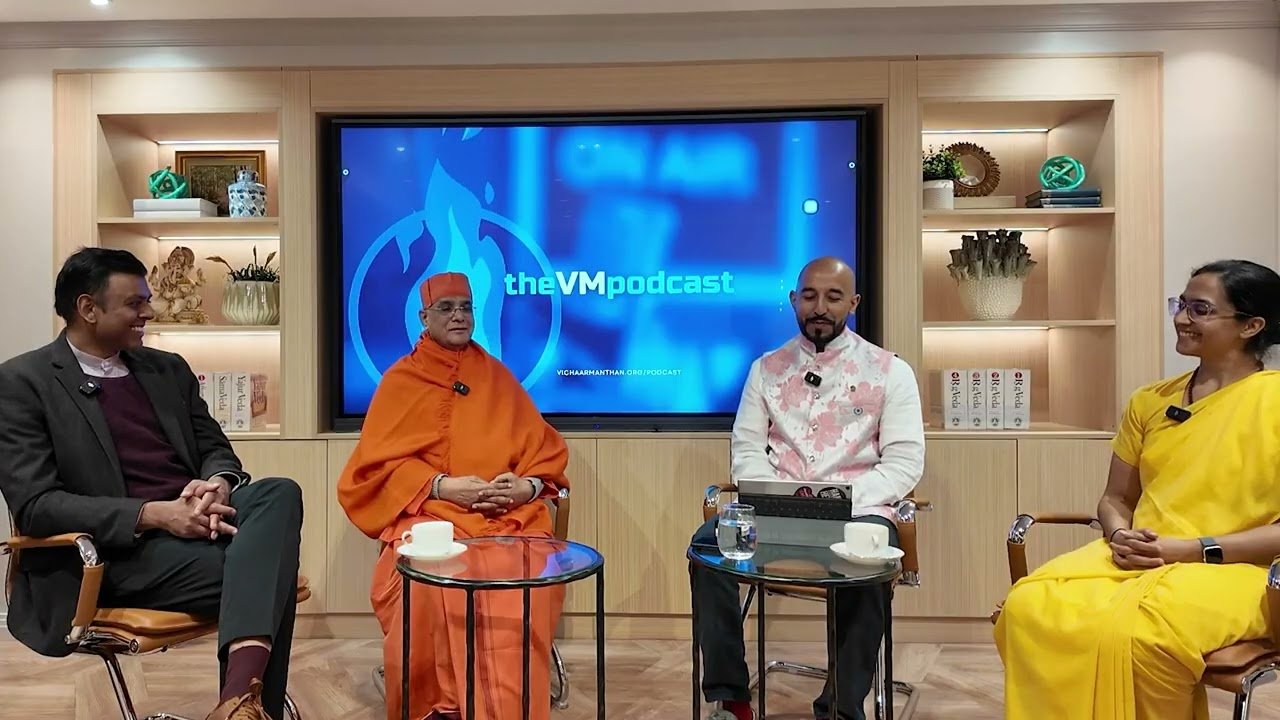
Sanatana Dharma: Hinduism Beyond Borders, Race and Theology
The 50th Episode of the Vichaar Manthan Podcast
The Vichaar Manthan Podcast recently reached a significant milestone with the release of its 50th episode, marking five years of conversations exploring contemporary issues through the philosophical and ethical perspectives of Hindu thought.
The podcast has reached listeners in more than 45 countries and has received over 32,000 views, providing a platform for thoughtful discussions about Hindu philosophy, culture, society, sustainability, freedom, and human flourishing.
Produced as a community initiative associated with Hindu Swayamsevak Sangh (UK), commonly known as HSS (UK), the podcast seeks to make Hindu philosophical ideas accessible to contemporary audiences. HSS (UK) is a voluntary cultural and community organisation that promotes personal development, community service, family wellbeing, and active citizenship while helping people engage with the heritage and values of Hindu and Indian culture.
Understanding Hinduism Beyond Geography
The 50th episode, titled “Sanatana Dharma: Hinduism Beyond Borders, Race and Theology,” explores one of the fundamental questions surrounding Hindu identity: what does it mean to be Hindu in a modern, global and increasingly diverse world?
The term Sanatana Dharma is often translated as the “eternal way of life” or “eternal principles.” It refers to a broad philosophical and spiritual tradition rather than a single creed, founder, scripture, or uniform system of belief.
The discussion examines whether Hinduism should be understood primarily through geographical, cultural, ethnic, or theological definitions. It considers how Hindu traditions can be understood beyond the historical and geographical boundaries of India and how Hindu philosophy can engage with people and communities around the world.
One of the central themes is the remarkable diversity within Hindu thought. Hindu traditions encompass a wide range of philosophical perspectives, including traditions centred on devotion to a personal form of God, traditions focused on philosophical enquiry and the nature of ultimate reality, and approaches that emphasise meditation, ethical action, knowledge, or self-discipline.
This diversity is not necessarily viewed as a contradiction. Instead, it can be understood as one of the defining characteristics of Hindu philosophy, where different approaches may provide different paths towards spiritual understanding.
Diversity Within Hindu Philosophy
The episode explores important questions surrounding different Hindu philosophical traditions, including perspectives associated with devotion to Krishna, the philosophy of non-duality, and other approaches to understanding the relationship between the individual, the universe, and ultimate reality.
The discussion considers whether apparently different schools of Hindu thought can find common ground through shared ethical principles and a broader understanding of Dharma.
In this context, Dharma can be understood as the principles of responsible and ethical living that support harmony, justice, duty, and the wellbeing of individuals and society. Rather than being simply a religious doctrine, the concept can encompass values and responsibilities that guide how people conduct themselves and relate to others and the natural world.
Hindu Traditions Around the World
The episode also examines the work of several organisations that have played significant roles in sharing Hindu philosophy with audiences in India and around the world.
These include the Ramakrishna Mission, the Chinmaya Mission, and ISKCON, each of which has developed distinctive approaches to Hindu teaching and practice.
The discussion considers different paths traditionally associated with Hindu spiritual development, including:
- Devotion — developing a loving relationship with the divine.
- Knowledge and philosophical enquiry — seeking to understand the nature of the self and ultimate reality.
- Selfless action — serving others without attachment to personal reward.
- Meditation and disciplined practice — developing greater control, awareness, and inner balance.
These approaches have enabled Hindu communities across the global diaspora to maintain connections with their cultural and philosophical heritage while adapting to new social and cultural environments.
For younger generations growing up outside India, such organisations can also provide opportunities to explore Hindu philosophy in ways that connect traditional teachings with contemporary questions about identity, purpose, wellbeing, and society.
From Philosophy to Everyday Life
An important part of the discussion is the relationship between philosophical principles and everyday behaviour.
The episode asks whether the values associated with Dharma should influence practical issues such as caring for humanity, protecting the environment, animal welfare, and our treatment of other forms of life.
Hindu traditions have historically placed considerable emphasis on the interconnectedness of life and the responsibility of human beings towards the natural world. Concepts such as compassion, moderation, responsible consumption, and respect for living beings provide a philosophical foundation for considering contemporary environmental and social challenges.
The conversation therefore asks an important question: If ethical principles are central to Hindu philosophy, how effectively are those principles reflected in the behaviour of individuals and communities today?
The Speakers
The episode brings together three distinguished voices representing different Hindu traditions and areas of scholarship.
Swami Atmapriyananda is Pro-Chancellor of the Ramakrishna Mission Vivekananda Educational and Research Institute. He holds a Master’s degree in Physics and a PhD in Theoretical Physics from the University of Madras. He joined the Ramakrishna Order of monks in 1978, inspired by the teachings of Sri Ramakrishna and Swami Vivekananda, with a particular emphasis on spiritual development, renunciation, education, and service.
Brahmacharini Shripriya Chaitanya is a Hindu monastic teacher, Vedantic scholar, author, and internationally recognised storyteller associated with the Chinmaya Mission. She completed an intensive two-year programme in Vedanta philosophy at the Chinmaya Mission’s Sandeepany Sadhanalaya in Mumbai and currently serves as a resident teacher with Chinmaya Mission UK.
Dr Sachi K. Patel holds a PhD in Hindu Theology from the University of Oxford and has experience as a Hindu monk within the ISKCON tradition. He currently serves as Multi-Faith Coordinator at SOAS University of London and as Hindu Chaplain at King’s College London.
Together, their perspectives provide a valuable opportunity to explore Hinduism from theological, philosophical, academic, monastic, and contemporary community perspectives.
A Conversation for a Global Hindu Community
The 50th episode of the Vichaar Manthan Podcast demonstrates the diversity and depth of contemporary conversations surrounding Hindu philosophy.
Rather than presenting Hinduism as a single uniform system, the discussion explores how different traditions, practices, and philosophical viewpoints can coexist within a broader Hindu framework.
For Hindu communities living outside India, these questions have particular relevance. As Hindu communities continue to grow across the United Kingdom and around the world, there is an increasing need to understand how cultural heritage, philosophical traditions, ethical responsibilities, and contemporary life can be brought together.
The episode ultimately invites listeners to look beyond labels and explore the deeper principles that connect different Hindu traditions—while also considering how those principles can be translated into meaningful action for individuals, communities, humanity, and the natural world.
The 50th episode of Vichaar Manthan therefore marks not only a milestone for the podcast but also an invitation to continue an open and thoughtful conversation about what Hindu philosophy can offer a changing world.